
Richer Rental
12 Tips and Tricks to help Cut Costs and Streamline your Airbnb in 2024
Airbnb not as profitable as you would like???
Check out these 12 Tips and Tricks to help Cut Costs and Streamline your Airbnb!
Table of Contents (clickable)
- Increase Your Airbnb Profits
- List of products in the above video:
- Home Made Cleaning Solution
Increase Your Airbnb Profits: Grassroots Strategies for Lowering Your Airbnb Bottom Line
Running a successful Airbnb or rental business hinges on maintaining a healthy balance between revenue and expenses. In challenging times, such as low occupancy rates or unexpected downturns, cutting costs becomes essential to staying in the game! Below I explore some practical grassroots tactics to help you trim expenses and boost your bottom line without compromising on quality or guest satisfaction.
- Optimize Operational Efficiency:
- Consider giving you cleaner ‘a break’ and taking on a few cleanings yourself, or take some time to research more cost-effective cleaning services.
- Implement energy-saving measures to reduce utility bills, such as installing programmable thermostats or switching to LED lighting.
- Consider turning down your heat or AC in between guest stays, especially if the gaps are more than a couple days (consider getting the Ecobee to be able to do this remotely from your phone).
- Negotiate lower rates with utility providers or explore alternative energy sources like solar power or heat pumps.
- Strategic Purchasing:
- Purchase cleaning supplies and essentials in bulk from wholesale retailers like Costco, Sam’s Club, or Walmart to take advantage of bulk discounts.
- Invest in high-quality, durable furniture and amenities that offer longevity and require minimal maintenance.
- Consider buying used from Facebook Market Place or Craigslist. This is where you will get the best bang for your buck.
- Similarly, explore second-hand or refurbished furniture options to furnish your property at a fraction of the cost of new items.
- DIY Maintenance and Upkeep:
- Save on landscaping expenses by maintaining your yard yourself or investing in low-maintenance landscaping solutions.
- Learn basic DIY repair skills to handle minor maintenance tasks like plumbing repairs, painting, or minor electrical work.
- Regularly inspect your property for issues to address them promptly, preventing costly repairs down the line… “a stich in time saves nine”.
- Streamline Guest Services:
- Utilize automated check-in and check-out processes to minimize the need for management costs, or taking up more of your time (allowing you to focus more on growing your business).
- Provide digital guides or instructional videos to guests to reduce the need for personal assistance and streamline the guest experience. Check out Hostfully – you get one FREE guest book account (I have got a lot of compliments on mine over the years).
Hopefully you found these tips helpful and can see how easy it is to save hundreds, if not thousands of dollars annually by implementing these grassroots strategies, and without having to compromise on service quality or guest experience. Embracing cost-saving measures and optimizing operational efficiency will not only improve your profitability but also enhance the resilience of your business during challenging times, be it local downtowns or recessions. Remember, every dollar saved contributes to the long-term success and sustainability of your Airbnb venture.
Home Made Cleaning Solution
Per 1 Liter bottle use:
-
- 1/4 White Vingar
- 3/4 Water
- 2-3 squirts dish soap (I like Sunlight)

Best Airbnb Security Cameras Without a Subscription
A security camera with a good phone app is one of the easiest ways to manage an Airbnb remotely. You can see guests arrive and leave, check for parties or extra people, watch for deliveries and contractors, and get some peace of mind while you’re away. These are the best Airbnb security cameras without a subscription for doing exactly that. I’m going to save you a lot of time, energy, research, and disappointment. I run our lake house cabin Airbnb, I installed the camera myself, and I don’t pay a monthly fee for it.
Affiliate disclosure: Some links below are Amazon affiliate links. As an Amazon Associate I earn from qualifying purchases, at no extra cost to you.
TL;DR
An outdoor camera with a phone app lets you run your rental from anywhere: see check-ins and check-outs, catch a party or too many cars early, watch for packages, cleaners and contractors, and stop wondering what’s going on while you’re away. Skip the monthly fee and get one that records to a memory card.
My pick for most hosts: the Tapo C520WS. Free app, live view and alerts on your phone, records to a microSD card, and it turns 360° so one camera covers the driveway and the entry. No outlet where you need it? Get the battery-powered Tapo C425 instead.
Why an Airbnb host needs a security camera with an app
A camera with a phone app lets you check your rental from anywhere with an internet connection. You see who arrives and leaves, spot problems early, and keep footage for claims, all without driving over.
Arrivals and departures
Get an alert when guests pull in, so you know they made it, and when they leave, so your cleaner can start.
Parties and extra guests
Six cars for a booking of two? You’ll see it in the app and can message the guest before it becomes a problem.
Deliveries and contractors
See when a package lands and when the plumber shows up (and leaves), without being there.
Peace of mind
When you’re away, a quick look at the app beats wondering what’s happening at the property.
Here’s what else I use mine for:
Turnovers
Check that your cleaner has showed up, and that the trash made it to the curb.
Did it snow???
Check the cameras to see if your driveway needs to be plowed before you or your guests arrive!
Evidence
Recorded footage can provide crucial evidence to law enforcement or for insurance claims. Hey, this time you will actually get your money back for stolen Amazon packages! 😅
Insurance savings
You may be eligible for discounts on your home insurance. Let your broker know the next time you renew!
- Two-way talk: talk to delivery drivers or visitors through the camera’s speaker.
- Fire prevention: make sure camp fires have been put out fully and properly!
- Energy savings: find out if lights have been left on, or things of that nature (e.g. sprinklers).
- Spot maintenance issues early: see damage or a problem before it becomes a major one.
- Beautiful wildlife: save and share the fun clips too.
The camera is just the tool. The app is what makes remote hosting easier. And with local storage: no more monthly bills to big name security companies! Want more ways to run your place remotely? See my 12 tips to cut costs and streamline your Airbnb and my Nest vs. ecobee thermostat comparison.
Quick picks: the best Airbnb security cameras without a subscription
For most hosts, a plug-in Tapo C520WS is the best no-subscription camera: the free Tapo app gives you live view and alerts, it records to a microSD card, and it costs less than one year of most cloud plans. If there’s no outlet, the battery Tapo C425 does the same job without wires.
| Camera | Best for | Resolution | Power | Storage | Subscription |
|---|---|---|---|---|---|
| Tapo C520WS Best for most hosts | Driveway and entry from one spot | 2K (4MP), 360° pan/tilt | Plug-in | microSD up to 512GB, 24/7 or motion | Not required |
| Tapo C425 No outlet needed | Gates, sheds, parking pads | 2K | Battery (solar optional) | microSD up to 512GB, motion clips | Not required |
| Lorex 4K Spotlight What I installed | Proof it works (see video) | 4K | Plug-in | microSD (32GB included) | Not required |
The Lorex model I installed is currently unavailable on Amazon.com, which is why it isn’t my buy-now pick anymore.
Best for most hosts
Tapo C520WS outdoor pan/tilt camera
- Storage: microSD card up to 512GB (card sold separately), with 24/7 or motion recording
- Subscription: none needed. Tapo’s cloud plan is optional.
- Remote viewing: live view, playback, 2-way talk and person/vehicle alerts in the Tapo app
- Outside: IP66 weatherproof, color night vision, light and siren alarm
Why hosts like it: one camera can swing between the parking area and the front door, so you need fewer cameras (and fewer things to disclose). 4.4 stars from thousands of Amazon reviews when I checked.
Check price on AmazonNo outlet? Get this one
Tapo C425 battery camera
- Storage: microSD up to 512GB, records motion clips (not 24/7)
- Subscription: none needed; free person, pet and vehicle detection
- Install: magnetic mount and a long-life battery, with an optional solar panel
Why hosts like it: no electrician and no wires to run to a gate or a detached garage. It uses the same app as the C520WS, so both cameras show up in one place.
Check price on AmazonWhat Airbnb’s camera rules allow
Airbnb allows exterior cameras only, and you have to disclose where each one is in your listing. Indoor cameras are banned, even if they’re switched off, and hidden cameras are never allowed.
Allowed (if you disclose it)
- Cameras on the driveway, front entry, yard, patio or pool
- Doorbell cameras (they count as recording devices)
- Noise decibel monitors that don’t record audio, kept out of bedrooms and bathrooms
Not allowed
- Any camera that monitors inside the home: hallway, living room, bedroom, bathroom, guest house
- Hidden cameras of any kind
- Cameras on private outdoor spots like an enclosed outdoor shower or a sauna
These rules took effect April 30, 2024. Read the full policy here: Airbnb’s rules on cameras and recording devices.
There’s a balance between keeping your place safe and secure, and your guest’s privacy. And this should be pretty obvious: do not install security cameras inside a rental dwelling, nor outside in a way that has a view into the dwelling. Never conceal recording devices of any kind.
How to disclose: in the Airbnb listing editor, go to Your space → Guest safety → Safety devices, check Exterior security camera present, and describe each camera, for example “I have a camera over the driveway and one at the front door.”
What to look for in a no-subscription camera
Look for local storage (a microSD card or a home base), free playback and alerts, remote viewing from your phone, and an outdoor rating of IP65 or better. If recorded clips need a paid plan, it isn’t really “no subscription”.
- Local storage: clips save to a card in the camera or a base station, not only to the cloud.
- Free playback and alerts: you can scroll back through footage and get person/vehicle alerts without paying.
- Remote viewing: live view and playback work when you’re hours away from the property.
- Weatherproof: IP65 or IP66, so it survives rain and snow.
- Power that fits the spot: plug-in for 24/7 recording, battery or solar where there’s no outlet.
- A light or siren: visible cameras are a deterrent, and a light that turns on when motion is detected makes it obvious.
Yes, there are cheaper models (e.g. light bulb cameras), but trust me, you get what you pay for.
Local storage vs. cloud: what it costs over 1 to 3 years
A local-storage camera costs the camera plus a one-time memory card. A cloud plan keeps billing you every month for as long as you want your clips, so over a few years the plan can cost more than the camera.
| Setup | Year 1 | Year 2 | Year 3 |
|---|---|---|---|
| Local microSD storage (any camera above) | $0 | $0 | $0 |
| Tapo Care cloud, 1 camera (about $35/yr) | $35 | $70 | $105 |
| Google Home Premium Standard, billed yearly ($100/yr) | $100 | $200 | $300 |
Running totals for subscription fees only, not including the camera itself. Plan prices from Google Store and Wirecutter as of October 2026. Prices change, so check before you buy.
That’s why I skipped the Nest-style cameras. They’re decent, but in the long run you will end up paying more (I’ve done the math)!
My setup: a Lorex 4K at our lake house cabin rental
At our lake house cabin Airbnb I use a Lorex 4K Wi-Fi camera with no subscription. It’s my example, not the only option: any camera with a good app and local storage does the job. Mine stores weeks of motion footage on its memory card, the app is easy, and I installed it myself.
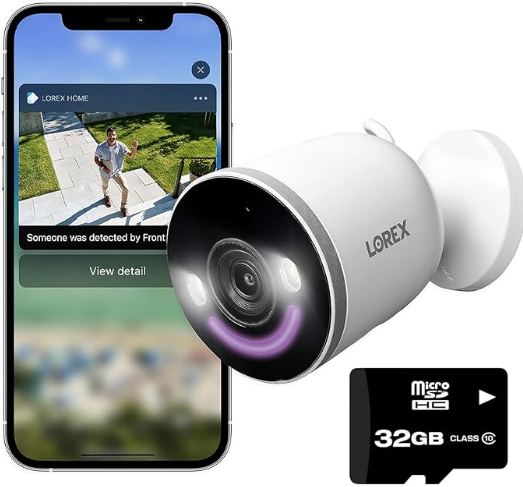
The storage on the Lorex 4K is solid, storing up to weeks of footage, with no subscriptions! The app is seamless and easy to use. The camera is very easy to install (see the video below). And for the techies, it’s compatible with Alexa and Google Home. The Lorex 4K also has a setting where a bright LED turns on when motion is detected, which does a lot of the deterring for you.
The whole install is in this video:
If you want the Lorex specifically, Lorex says this camera keeps recordings on the included 32GB microSD card with no monthly fees. It’s currently unavailable on Amazon.com. I bought mine in-store at Costco, or check Lorex directly.
Setup and placement tips for Airbnb
Point cameras at the ways in (driveway, front door, parking) and keep them away from windows, bedrooms, bathrooms and private outdoor areas. Then list every camera in your Airbnb listing before guests book.
- Cover entrances only. Driveway, front entry, side gate, parking pad. That’s what you need for cars, packages and party checks.
- Check the view from the app. If a camera can see into the house through a window, re-aim it or use the app’s privacy zones to black that part out.
- Never near sleeping or bathroom areas, and not over a hot tub, enclosed outdoor shower or sauna.
- Mount high and out of reach, under a soffit if you can, so rain and curious guests stay off the lens.
- Put the camera on your own Wi-Fi network (or a separate one from guest Wi-Fi) and turn on two-step login in the app.
- Disclose it. Add each camera’s location under Guest safety, and mention it in your house manual too.
- Use a good card. A high-endurance microSD card lasts longer with constant recording.
Install supplies
You need a drill, the right screws for your wall or soffit, and a nut driver bit for hex-head screws. Everything else comes in the camera box.
For the DIY-ers, here is a simple list of supplies you may need for the install. Personally, I can almost always justify buying new tools for a job if the tool cost is about what I would pay for someone else to do the job for me (even if I think I might never need the tool again, but that’s just me).
Cordless drill
Drill is easiest, and is essential if you want to secure to aluminum soffits with self tapping screws as I did.
DEWALT 20V Max compact drill (DCD771C2)Ratcheting multi-bit screwdriver
For the mounting plate and tight spots where the drill won’t fit. Bits live in the handle.
Klein Tools 32305 15-in-1 ratcheting screwdriverSelf-tapping screws
My camera came with screws and fasteners!!! But it didn’t have self tapping screws. These are required for securing to metal surfaces like I did in the video.
Stainless #8/#10 self-drilling screw kitMagnetic nut driver bits
Hex bits/heads for the self-tapping screws, so they drive straight without stripping.
SEDY 12-piece magnetic nut driver setShoe Goo
Ok, so pretty much my favorite around-the-house product of all time! It is slightly flexible, highly durable, clear, and waterproof, and binds to all materials exceptionally well. Epoxy is good, but it isn’t great for binding plastic to plastic like I demonstrated with the deflector I installed on the backyard security camera. Each tube pays for itself many times over. Love this stuff.
Shoe Goo clear adhesiveFAQ
Why should an Airbnb host get a security camera with an app?
So you can manage the rental remotely: see arrivals and departures, catch parties or extra guests, watch for deliveries and contractors, and check on the place while you’re away. Pick one that records locally so there’s no monthly fee.
What are the best security cameras for Airbnb?
Outdoor cameras that record locally with no subscription, like the Tapo C520WS (plug-in) or the Tapo C425 (battery). Put them on entrances only and disclose them in your listing.
Can Airbnb hosts have security cameras?
Yes, but only outside, and you have to disclose each camera’s location in your listing before guests book. Indoor cameras are banned, even if they’re turned off, and hidden cameras are never allowed.
Do I need to disclose a doorbell camera?
Yes. Airbnb counts doorbell cameras as recording devices, so list them under Guest safety like any other exterior camera.
What security cameras work without a subscription?
Look for cameras that record to a microSD card or a home base and give you free playback and alerts. Tapo, Lorex, Reolink and eufy all sell cameras like this.
Can Lorex cameras work without a subscription?
Yes. My Lorex 4K Wi-Fi camera records to a microSD card with no monthly fee, and I watch it from the Lorex app. Check the storage details on any specific model before you buy.
Can you use a Google Nest camera without a subscription?
Yes, but without Google Home Premium you only get about 3 hours of event video history. That’s fine for a quick check, but not if you need to see what happened last weekend between two guest stays.
What is the best wireless security camera system with remote viewing?
For a rental, pick cameras that all work in one free app. Both Tapo picks above use the same app, so you can watch live and play back clips from anywhere with an internet connection.
Can I use a noise monitor inside my Airbnb?
Yes, as long as it only measures decibel levels without recording audio, isn’t in a bedroom, bathroom or sleeping area, and you disclose that you have one.
Get my free host toolkit
Printable septic signs, the room-by-room cleaning checklist I give my cleaner, and occasional hosting tips by email.
Attention Airbnb or VRBO owners!
Liking what you are seeing?! Grab my free septic bathroom sign. This printable and frameable sign could save you thousands in septic bills. And here’s my free Airbnb cleaning checklist.
Want to get started on Airbnb? Use my referral link (I may earn a referral reward).
Should You Build a Vacation Rental Website
The short answer… YES! (for the vast majority of cases)
As a savvy Airbnb host, you know that having a great online presence is key to success. But did you know that having your own website can give you a serious advantage over your competitors? Here are just a few of the many benefits of having your own website for your Airbnb:
- You control the narrative: When potential guests search for your listing on Airbnb, they’re seeing your property through the lens of Airbnb’s platform. But with your own website, you have the ability to present your property exactly how you want it to be seen. You can showcase more photos, highlight specific amenities or features, and give potential guests a more personal look at what makes your property unique.
- It can improve your search rankings: When people search for accommodations online, they’re often using Google or another search engine. By having your own website, you have the opportunity to optimize your content for search engines, which can help your website show up higher in search results. This means more visibility for your property and potentially more bookings.
- You can build your brand: Your Airbnb property is just one aspect of your business. By having your own website, you can start to build a brand around your property and your hosting style. This can help you stand out from the competition and give potential guests a reason to choose your property over others.
- It’s a professional touch: Let’s face it, having your own website just looks more professional. It shows potential guests that you take your hosting seriously and that you’re willing to invest in your business. Plus, having your own website can help establish trust with potential guests who might be hesitant to book with a stranger on Airbnb.
- You can collect guest information: When guests book through Airbnb, you’re limited in terms of the information you’re able to collect. But with your own website, you can collect email addresses, phone numbers, and other information that can help you market to past guests and build a loyal following.
Overall, having your own website is a smart move for any Airbnb host who wants to take their business to the next level. Whether you’re just starting out or you’re a seasoned host, investing in a website can help you stand out from the crowd, improve your search rankings, and build a brand that guests will remember. So why wait? Start building your website today and watch your bookings soar!
How to Avoid Capital Gains Tax on Rental Property Canada
I present to you… THE SMITH MANEUVER
If you’re a Canadian homeowner, you may have heard of the Smith Maneuver. It’s a strategy that’s been gaining popularity in recent years as a way to make your mortgage tax-deductible and build wealth over the long term. In this post, we’ll explain how the Smith Maneuver works and why you might want to consider it.
What is the Smith Maneuver?
The Smith Maneuver is a financial strategy that allows Canadian homeowners to convert non-deductible mortgage interest into tax-deductible investment interest. The strategy is named after Fraser Smith, the financial planner who developed it in the 1980s.
Here’s how it works:
1. Borrow against the equity in your home: First, you’ll need to take out a home equity line of credit (HELOC) against the equity in your home. This is essentially a loan that’s secured by your home. The amount you can borrow depends on how much equity you have in your home.
2. Invest the borrowed money: Next, you’ll take the money you borrowed from your HELOC and invest it in income-producing assets like stocks, mutual funds, or exchange-traded funds (ETFs). The goal is to earn enough income from your investments to cover the interest on your HELOC.
3. Claim the interest as a tax deduction: Because the interest you pay on your HELOC is used to invest in income-producing assets, you can claim the interest as a tax deduction on your income tax return. This means you’ll pay less tax overall.
4. Use the investment income to pay down your mortgage: Finally, you’ll use the investment income you earn to pay down your mortgage faster. By doing this, you’ll reduce the amount of non-deductible mortgage interest you pay over time.
For detailed information, check out this book dedicated to the subject:

Get Master Your Mortgage for Financial Freedom on Amazon
Why should Canadians consider the Smith Maneuver?
There are a few reasons why Canadians might want to consider the Smith Maneuver:
1. Tax savings: By converting non-deductible mortgage interest into tax-deductible investment interest, you can lower your overall tax bill. This can save you thousands of dollars over the long term.
2. Faster mortgage paydown: By using investment income to pay down your mortgage faster, you can potentially save tens of thousands of dollars in interest charges over the life of your mortgage.
3. Building wealth: By investing the borrowed money in income-producing assets, you have the potential to earn a higher return on your money than you would by simply paying down your mortgage. Over the long term, this can help you build wealth and achieve your financial goals faster.
4. Flexibility: The Smith Maneuver is a flexible strategy that can be customized to your individual needs and goals. You can choose how much to borrow against your home equity, which investments to make, and how quickly to pay down your mortgage.
Concluding remarks:
Of course, as with any financial strategy, there are risks and potential downsides to consider. For example, investing always carries some level of risk, and you may not earn a high enough return to cover the interest on your HELOC. Additionally, borrowing against your home equity can be risky if your home value declines, as you could end up owing more than your home is worth.
Overall, the Smith Maneuver is a strategy that can make sense for certain Canadian homeowners who are comfortable with investing and understand the potential risks involved. If you’re interested in learning more, it’s a good idea to speak with a financial advisor who can help you determine whether the Smith Maneuver is right for you.
25 years and still a best seller?! Hint: it’s still making people rich!
Ok, well the book itself is not making people rich, but the knowledge and numerous “aha moments” will! I have listened to thousands of hours of interviews with some of the richest and most successful people in the world — this book is mentioned more than any other, hands down. Why? Well for one, this book change how you see money (or at least it should). We are not taught much financial education in school, and if anything the information we are given is arguably useless. Following the very inspirational and eye-opening chapters of this book, the author does an outstanding job of showing how it is possible for almost anyone to build wealth through investing in assets such as real estate and small businesses, rather than relying solely on traditional forms of income.
Alright, it’s the 21 century and attention spans are short, so without further ado I will reveal this book, followed by some remaining notes and personal takes:
Rich Dad Poor Dad
Get Rich Dad Poor Dad on Amazon
Ok, maybe you’ve heard of this book, maybe not. If you have, great, but do not eye roll — less we not forget that books do not become best sellers for no reasons.
I was first turned onto to this site in my quest for passive income and was impressed by the richerrental.com‘s down to earth and “real” take on this books, as well as their other three top picks.
Alright, now for my closing points:
• This book cannot be unread! When was the last time someone said that about book?
• The storytelling is motivational and the financial opportunity insights made it hard to put the book down.
• This book is basically pandora’s box. Once I finshed reading this book I went on to read dozens more on related topics as well as started my YouTube binge journey, devouring as much financial content as a could.
Today, I am not yet a rich man, but I am well on my way. I don’t think I would be even close to where I am today without the book. Take a read, and check it out. The worst that can happen is saying that you read one of the best selling books in the world and thought it was meh!
Debt Consolidation = Real Estate Investing Opportunity?
Debt consolidation is a financial strategy that involves combining multiple high-interest debts into a single, low-interest loan. This can be a great way to get a handle on your debt and improve your financial situation.
Here are the top 15 benefits of going ahead with debt consolidation:
- Lower interest rates: By consolidating your debt, you can often qualify for a lower interest rate, which can save you money on interest charges over time.
- Lower monthly payments: Consolidating your debt can also lower your monthly payments, making it easier to afford your debt repayment.
- Simplified budgeting: With just one monthly payment to worry about, it’s easier to budget and track your debt repayment progress.
- Fewer creditor calls: When you consolidate your debt, you will only have to deal with one lender, rather than multiple creditors, which can be a relief.
- Improved credit score: As you pay off your debt, your credit score will improve, which can open up more financial opportunities for you in the future.
- Stop collection calls: Consolidating your debt could stop the collection calls and letters you are receiving from your creditors.
- Reduced stress: Dealing with multiple high-interest debts can be stressful, consolidating your debt can help reduce this stress.
- Peace of mind: Knowing that you are taking steps to get control of your debt can give you peace of mind and a sense of accomplishment.
- Tax benefits: Some types of debt consolidation loans, like home equity loans, may offer tax benefits.
- Avoid bankruptcy: Consolidating your debt can help you avoid the negative financial and personal consequences of bankruptcy.
- Flexibility: Many consolidation loans offer flexible repayment options, such as the ability to adjust the loan term, making it easier to fit the payments into your budget.
- Avoid late fees: Late fees and penalties can add up quickly, consolidating your debt can help you avoid these additional charges.
- Avoid wage garnishment: If you are unable to pay your debts, your creditors may seek wage garnishment, consolidating your debt can help you avoid this.
- Access to additional funds: If you consolidate your debt through a home equity loan or line of credit, you may have access to additional funds that you can use for other purposes.
- Debt-free quicker: By consolidating your debt, you can pay off your debts quicker and become debt-free sooner.
At the end of the day, debt consolidation can be a great way to get a handle on your debt and improve your financial situation. From lower interest rates and monthly payments to improved credit scores and reduced stress, the benefits of debt consolidation are numerous. However, it’s important to do your research and choose the right type of consolidation loan for your needs, and make sure you have a plan to avoid falling into debt again. A financial advisor or credit counselor can help you evaluate your options and make the best decision for your financial situation.
Cash Out Refinance To Buy Second Home
The BRRRR Strategy:
“Buy, Renovate, Rent, Refinance, Repeat,” is a real estate investment strategy that allows investors to acquire properties, improve them, and then refinance them at a higher value to pull cash out and repeat the process.
In this blog post, we will discuss two common ways to access the equity in your home: a Home Equity Line of Credit (HELOC) and a Cash-Out Refinance. We will also introduce the BRRRR strategy, a popular real estate investment approach that allows investors to acquire properties, improve them, and then refinance them at a higher value to pull cash out to acquire another property. We will run through some real life BRRRR examples later on in the post!
A HELOC is a revolving line of credit that allows you to borrow against the equity in your home. It works much like a credit card, with a credit limit based on the value of your home and the amount of equity you have. You can borrow as much or as little as you need, and you only pay interest on the amount you borrow. HELOCs typically have variable interest rates, which means your payments may fluctuate over time.
On the other hand, a Cash-Out Refinance involves taking out a new mortgage to replace your existing one. The new mortgage is for a larger amount than your current mortgage, and the difference between the two is paid out to you in cash. This cash can then be used for a variety of purposes, such as home improvements, debt consolidation, or other large expenses. Cash-Out Refinances usually have fixed interest rates, meaning your monthly payments will remain the same over the life of the loan.
Key Differences: HELOC vs. Cash-Out Refinance:
Interest Rates:
- HELOCs generally have variable interest rates.
- Cash-Out Refinances typically have fixed interest rates.
Loan Terms:
- HELOCs have a draw period and a repayment period.
- Cash-Out Refinances have a fixed loan term (usually 15 or 30 years).
Access to Funds:
- With a HELOC, you can borrow and repay funds as needed, up to your credit limit.
- With a Cash-Out Refinance, you receive a lump sum of cash at the time of closing, and you cannot borrow additional funds unless you refinance again.
Closing Costs:
- Both HELOCs and Cash-Out Refinances may have closing costs associated with them.
- The closing costs for a Cash-Out Refinance are typically higher, as they involve the costs of originating a new mortgage.
The BRRRR strategy, which stands for “buy, renovate, rent, refinance, repeat,” is a real estate investment strategy that allows investors to acquire properties, improve them, and then refinance them at a higher value to pull cash out and repeat the process.
The first step of the BRRRR strategy is to find a property that can be purchased below market value. This can be done by searching for foreclosures, short sales, or properties that need significant repairs. Once the property is acquired, the investor will renovate it to increase its value and make it more attractive to renters.
The next step is to re-rent the property at a higher rate than the monthly mortgage payment. This will create positive cash flow, which can be used to pay for the renovations and other expenses.
Once the property has been stabilized and is generating positive cash flow, the investor can refinance the property at a higher value than what was originally paid. This will allow the investor to pull cash out of the property, which can then be used to repeat the process and acquire more properties.
The BRRRR strategy is a great way for investors to grow their real estate portfolio and create long-term wealth. However, it does require a significant amount of capital and knowledge of real estate and renovation to be successful.
Let’s go through a couple hypothetical examples of the BRRRR strategy, using some realistic numbers:
Initial Purchase Price: $300,000
Down Payment (20%): $60,000
Renovation Budget: $20,000
Total Investment: $80,000
Now, let’s assume that the property’s value increases by 20% after renovations. This would bring the new value to $360,000 (based on the appraised value – yes, you need to get the property appraised as part of the process).
New Appraised Value: $360,000
Next, you’ll need to determine the loan-to-value (LTV) ratio for refinancing. A common LTV ratio for investment properties is around 75%. This means that the maximum loan amount would be 75% of the new appraised value, or $270,000.
Maximum Loan Amount: $270,000 (this is the refinanced “cash out” you get)
However you still have to subtract the existing mortgage balance from the maximum loan amount to determine the net cash-out amount. In this case, let’s assume the existing mortgage balance is $240,000 (remember, we put of 20% down ($60k) on the $300k purchase price).
Net Cash-Out Amount: $270,000 – $240,000 = $30,000
Now, subtract the cash-out amount from your total investment to see if you can recover your entire down payment.
Total Investment (down payment + reno costs): $80,000
Cash-Out Amount: $30,000
Remaining UN-recovered initial Investment: $50,000
In this example, you would not be able to recover your initial investment of $80k (down payment + reno), as the cash-out amount is only $30,000. To break even and recover your full down payment, you would need a higher percentage increase in property value after renovations.
For example, if the property’s value increased by 40% after renovations, the new value would be $420,000. Using the same LTV ratio of 75%, the maximum loan amount would be $315,000. Subtracting the existing mortgage balance of $240,000 would result in a cash-out amount of $75,000.
Cash-Out Amount: $315,000 – $240,000 = $75,000
Did we get our full initial investment back this time?!
Total Investment: $80,000
Cash-Out Amount: $75,000
Remaining UN-recovered initial Investment: $5,000
Not too shabby! In this example we recovered our full down payment of $60,000 and most of our renovation costs, meaning we could repeat another BRRRR (e.g. maybe we put in a bit more sweat-equity this time to make up for the $5k less of reno budget). Keep in mind that this example is simplified and doesn’t include closing costs, taxes, and other factors that can impact the actual numbers. But as you can see, the BRRRR strategy is legit – though the “perfect” BRRRR is not all that easy. It requires finding the right undervalued property and a good deal of involvement to improve it such that it can be reappraised for a sufficiently higher value (e.g. as much as 30-40% more than what you bought it for).
In conclusion, both HELOCs and Cash-Out Refinances offer homeowners a way to access the equity in their homes, while the BRRRR strategy provides real estate investors with a powerful method to acquire, renovate, and refinance properties for long-term growth. The best option for you will depend on your individual financial situation, your goals, and your preferences. Be sure to carefully consider the pros and cons of each option before making a decision.
Meet Kevin vs Grant Cardone
Real estate investing is a popular way to build wealth, and there are many resources available to help you learn the ins and outs of the industry. Two of the most well-known names in real estate education are Meet Kevin and Grant Cardone. Both of these companies offer a variety of courses and resources to help you get started in real estate investing, but there are some key differences between the two.
Meet Kevin is a real estate education company founded by Kevin Paffrath, a successful real estate investor and educator. Kevin offers a variety of courses, including the “Real Estate Investing From $0 to Millionaire & Beyond” program, which is designed to teach you the basics of real estate investing and help you build a solid foundation for your business. The course covers topics such as finding deals, financing, and property management. Meet Kevin also offers a mentorship program, which provides one-on-one coaching and support to help you achieve your goals.

Grant Cardone, on the other hand, is a sales and marketing expert who has also made a name for himself in the real estate industry. His company, Cardone Capital, offers a variety of courses to help you build wealth through real estate investing, including “The 10X Rule” and “How to Create Multiple Flows of Income” programs. This course is designed to help you scale your real estate business and achieve financial freedom. The course covers topics such as finding deals, raising capital, and scaling your business. Grant Cardone also offers coaching and mentorship programs, as well as a variety of other resources to help you succeed in real estate investing.

One of the main differences between Meet Kevin and Grant Cardone is their approach to real estate investing. Meet Kevin focuses on building a solid foundation and steady growth, while Grant Cardone focuses on scaling and achieving financial freedom. Meet Kevin’s course is more beginner-friendly and focuses on teaching the basics, while Grant Cardone’s course is geared towards more experienced investors looking to scale their business.
Another key difference is the price point of the courses. Meet Kevin’s course is generally more affordable than Grant Cardone’s.
Ultimately, both Meet Kevin and Grant Cardone offer valuable resources for real estate investors, and the best choice for you will depend on your goals and experience level. If you’re just getting started in real estate investing, Meet Kevin’s course may be a better fit for you. However, if you’re an experienced investor looking to scale your business, Grant Cardone’s course may be more suitable. It’s always best to do your research, read reviews and testimonials, and choose the course that best aligns with your goals.
If after reading this you’re still not interested training / learning through courses, then you can always go through the self taught route. I highly encourage you check out my top recommended real estate / how to earn passive income books on this post: Top 3 Passive Income Books + Bonus pick!
Why You Should Take A Course On Real Estate Investing
Real estate courses pay for themselves in the time and money they will save you!
Not to mention, they will help you think outside the box and find the real estate deal or strategy that is best for you!
Real estate investing can be a great way to build wealth, but it can also be a complex and challenging endeavor. One of the best ways to gain the knowledge and skills needed to succeed in real estate investing is by taking a course on the subject.
Here are 10 reasons why it would be beneficial to take a course on real estate investing instead of trying to learn it on your own:
- Expert instruction: A course on real estate investing will be taught by experts in the field who have a wealth of knowledge and experience to share. They will be able to answer your questions and provide valuable insights that you wouldn’t be able to get on your own.
- Structured learning: A course on real estate investing will provide you with a structured learning experience that will help you absorb the material more effectively. This can be especially beneficial for those who find it difficult to learn on their own.
- Networking opportunities: Taking a course on real estate investing will give you the opportunity to meet and network with other like-minded individuals who are also interested in the field. This can be a great way to make connections and learn from others.
- Hands-on experience: Many real estate investing courses offer hands-on experience through field trips, case studies, and other practical exercises. This can be a great way to see how the concepts you’re learning about are applied in real-world situations.
- Access to resources: A course on real estate investing will provide you with access to a wide range of resources, including books, articles, and websites, that can help you learn more about the subject.
- Certification: Some real estate investing courses offer certification upon completion, which can be a valuable asset when looking for employment or seeking to build credibility with potential clients.
- Avoiding costly mistakes: Real estate investing can be a complex field and it’s easy to make costly mistakes. A course on real estate investing can help you avoid these mistakes and save you money in the long run.
- Keeping you updated with the latest trends and regulations: Real estate market and regulations are constantly changing, a course on real estate investing will keep you updated with the latest trends and regulations in the industry.
- Achieving your goals faster: By taking a course on real estate investing, you can gain the knowledge and skills you need to achieve your goals faster than if you were to try to learn on your own.
- Better return on investment: By gaining the knowledge and skills through a course on real estate investing, you can make better investment decisions, and in turn, achieve a better return on your investment.
At the end of the day, taking a course on real estate investing can be a great way to gain the knowledge and skills needed to succeed in the field. From expert instruction and structured learning to networking opportunities and hands-on experience, there are many benefits to taking a course on real estate investing. Additionally, it can help you avoid costly mistakes, stay updated with the latest trends and regulations, achieve your goals faster, and achieve a better return on investment. It’s worth considering taking a course on real estate investing if you’re serious about building wealth through real estate.
Best (2023) Property Management Software Operation Automation to Business
Property management is a complex and time-consuming task that requires a wide range of skills and knowledge. Fortunately, technology has made it easier for property managers to keep track of their properties and tenants, streamline their operations, and maximize their income. One of the most popular ways to do this is through the use of property management software.
There are many different types of property management software available, each with its own set of features and capabilities. In this article, we will take a look at some of the most popular property management software options on the market today, and discuss the key features and benefits of each.
AppFolio: AppFolio is a cloud-based property management software that provides a comprehensive set of tools for managing rental properties. Some of the key features of AppFolio include property and tenant management, accounting and financial reporting, online rent collection, and marketing and lead management. AppFolio also offers a mobile app that allows property managers to access their data from anywhere and stay on top of their properties and tenants.
Buildium: Buildium is another cloud-based property management software that provides a wide range of tools for managing rental properties. Some of the key features of Buildium include property and tenant management, accounting and financial reporting, online rent collection, and marketing and lead management. Buildium also offers a mobile app that allows property managers to access their data from anywhere and stay on top of their properties and tenants.
Propertyware: Propertyware is a cloud-based property management software that provides a comprehensive set of tools for managing rental properties. Some of the key features of Propertyware include property and tenant management, accounting and financial reporting, online rent collection, and marketing and lead management. Propertyware also offers a mobile app that allows property managers to access their data from anywhere and stay on top of their properties and tenants.
Yardi: Yardi is a comprehensive property management software that provides a wide range of tools for managing rental properties. Some of the key features of Yardi include property and tenant management, accounting and financial reporting, online rent collection, and marketing and lead management. Yardi also offers a mobile app that allows property managers to access their data from anywhere and stay on top of their properties and tenants.
Rent Manager: Rent Manager is a property management software that provides a comprehensive set of tools for managing rental properties. Some of the key features of Rent Manager include property and tenant management, accounting and financial reporting, online rent collection, and marketing and lead management. Rent Manager also offers a mobile app that allows property managers to access their data from anywhere and stay on top of their properties and tenants. Additionally, Rent Manager offers a variety of integrations with other software, such as QuickBooks and Yardi, which can help streamline operations and automate tasks.
ResMan: ResMan is a cloud-based property management software that offers a comprehensive set of tools for managing multifamily properties. Some of the key features of ResMan include property and tenant management, accounting and financial reporting, online rent collection, and marketing and lead management. ResMan also offers a mobile app that allows property managers to access their data from anywhere and stay on top of their properties and tenants. Additionally, ResMan offers integrations with other software such as Yardi and QuickBooks, which can help streamline operations and automate tasks.
MRI Software: MRI Software is a comprehensive property management software that offers a wide range of tools for managing commercial and residential properties. Some of the key features of MRI Software include property and tenant management, accounting and financial reporting, online rent collection, and marketing and lead management. MRI Software also offers a mobile app that allows property managers to access their data from anywhere and stay on top of their properties and tenants. Additionally, MRI Software offers integrations with other software such as Yardi and QuickBooks, which can help streamline operations and automate tasks.
Entrata: Entrata is a cloud-based property management software that provides a comprehensive set of tools for managing rental properties. Some of the key features of Entrata include property and tenant management, accounting and financial reporting, online rent collection, and marketing and lead management. Entrata also offers a mobile app that allows property managers to access their data from anywhere and stay on top of their properties and tenants. Additionally, Entrata offers integrations with other software such as Yardi and QuickBooks, which can help streamline operations and automate tasks. Entrata also offers a unique feature of having a resident portal that allows tenants to access their account information, pay rent, and submit maintenance requests.
RealPage: RealPage is a comprehensive property management software that offers a wide range of tools for managing commercial and residential properties. Some of the key features of RealPage include property and tenant management, accounting and financial reporting, online rent collection, and marketing and lead management. RealPage also offers a mobile app that allows property managers to access their data from anywhere and stay on top of their properties and tenants. Additionally, RealPage offers integrations with other software such as Yardi and QuickBooks, which can help streamline operations and automate tasks. RealPage also offers a unique feature of having a resident portal that allows tenants to access their account information, pay rent, and submit maintenance requests.
Rentec Direct: Rentec Direct is a cloud-based property management software that offers a comprehensive set of tools for managing rental properties. Some of the key features of Rentec Direct include property and tenant management, accounting and financial reporting, online rent collection, and marketing and lead management. Rentec Direct also offers a mobile app that allows property managers to access their data from anywhere and stay on top of their properties and tenants. Additionally, Rentec Direct offers integrations with other software such as QuickBooks and Yardi, which can help streamline operations and automate tasks. Rentec Direct also offers a unique feature of having a resident portal that allows tenants to access their account information, pay rent, and submit maintenance requests.
In conclusion, there are many different types of property management software available, each with its own set of features and capabilities. The software mentioned above are some of the most popular options on the market today, and provide a comprehensive set of tools for managing rental properties. From property and tenant management to accounting and financial reporting, online rent collection, and marketing and lead management, these software can help property managers streamline operations, save time and money, and improve the overall performance of their properties. It’s important to research and choose the software that best for your needs!